What Are the Signs of a Failing Drain Field?
Four signs come up again and again. The ground over the field turns wet or spongy. The yard smells like sewage. Drains run slow or back up even after the tank was pumped.
A stripe of bright green grass over the trenches is the fourth. The EPA lists all of these as signs of a failing system. When two or more show up together, the field is usually where the trouble is.
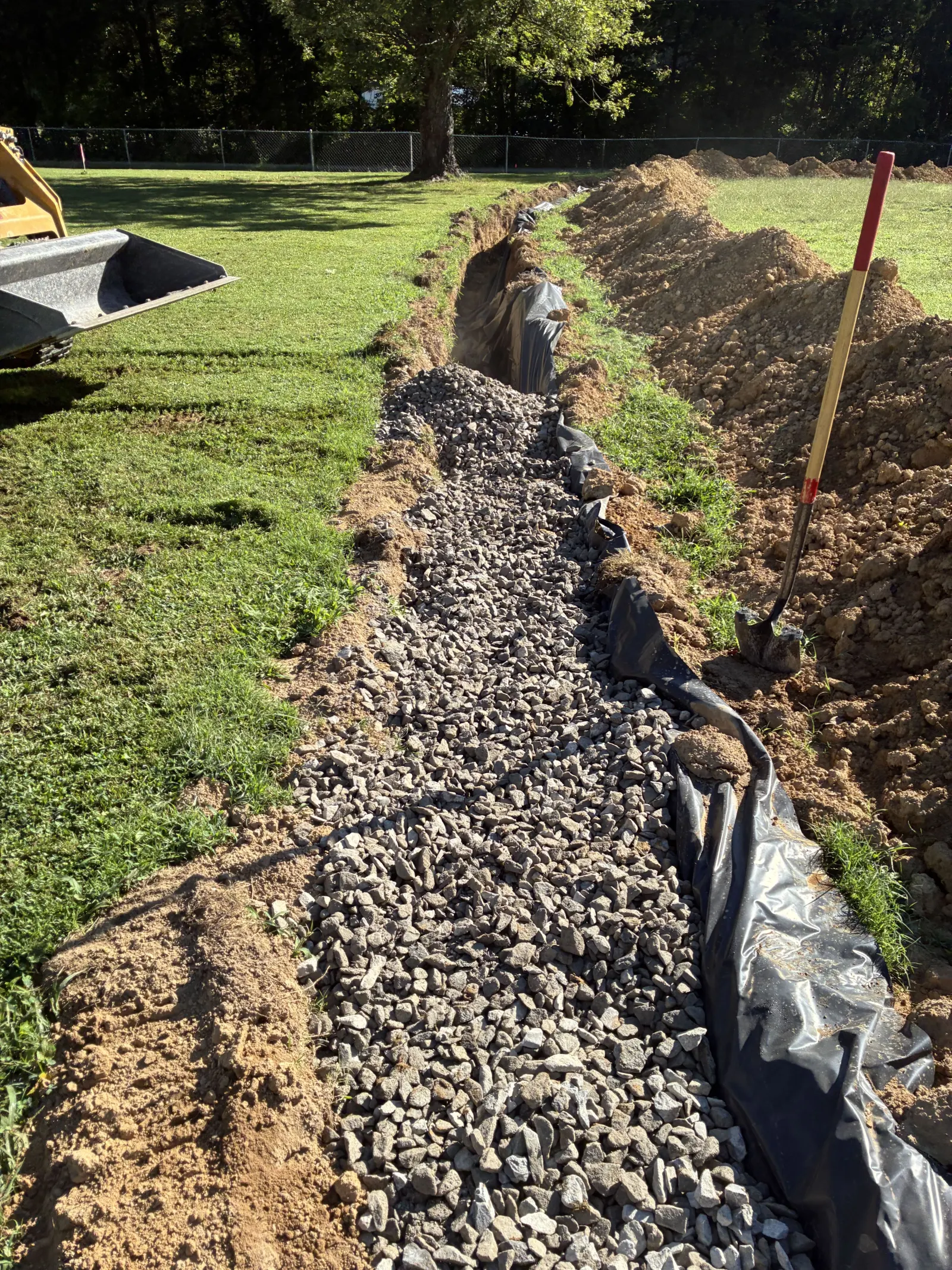
A drain field fails when the soil under it stops accepting water. The EPA describes the field as a shallow covered excavation in unsaturated soil. Once it floods, sewage flows to the ground surface or backs up into toilets and sinks.
National cost guides put the average life of a leach field at 15 to 25 years. Past 25 to 30 years, the EPA says the natural biomat in the trench bottoms thickens. A thick biomat cuts how much water the field can take.
Why Is the Ground Over the Drain Field Wet or Spongy?
Water on top of the field means the trenches below cannot take any more. The effluent has nowhere to go but up. The EPA lists standing water or damp spots over the tank or the field as a failure sign.
Check the ground a day or two after the rain stops. Soft, springy ground where the rest of the yard has dried is the tell. A boot print that fills with water is a stronger one.
Keep vehicles and equipment off that ground. Wet soil packs down, and packed soil takes even less water.
Why Does the Yard Smell Like Sewage?
A field that has stopped absorbing pushes effluent close to the surface. The smell comes up with it. The EPA lists sewage odors around the tank or the drainfield as a failure sign.
Odor on its own is not proof. A dry floor drain trap, a loose tank lid, or a cracked vent can smell the same way. Odor plus wet ground over the trenches points at the field.
We Pumped the Tank. Why Does It Still Back Up?
This is the clearest test between a tank problem and a field problem. If a tank is pumped and refills within days or weeks, the tank is not the cause. That liquid is coming back from a field that will not take it.
Slow drains and gurgling pipes are on the EPA’s list too. One slow fixture by itself is usually a clog in the house line, which is drain cleaning work. Every drain in the house running slow at once points downstream.
Routine septic tank pumping every three to five years is the EPA’s guidance. Pumping protects the field from solids. It will not open a field that has already clogged shut.
What Does Bright Green Grass Over the Field Mean?
The EPA’s wording is bright green, spongy lush grass over the septic tank or drainfield, even during dry weather. The stripe follows the trench lines. Effluent is watering and feeding the grass right above the pipe.
In a wet spring the whole lawn is green and the stripe hides. In a dry August it stands out against brown grass.
Why Do Drain Fields Fail in Middle Tennessee?
Greenbrier sits on the Highland Rim north of Nashville. The soil here works against a drain field. USDA soil series descriptions cover the Highland Rim soils. Dickson and Sango both carry a fragipan 18 to 36 inches down.
A fragipan is a dense layer that water moves through slowly. Permeability is moderate above it and slow to very slow inside it. Effluent that reaches that layer spreads sideways instead of soaking down.
That silty topsoil sits over limestone residuum, and in places rock is close to the surface. Karst ground with sinkholes and caves runs across Middle Tennessee. Wet winters and springs pile more water onto a field that already drains slowly.
The EPA names the same causes. Fields fail on soils that were never right for the load. Steep slopes and high ground water do it too. So does a tank that goes unpumped until solids reach the trenches.
Is It the Tank or the Field?
Tank-side failures have their own signs. A dead pump, a stuck float, a sounding alarm, or a cracked inlet line will back a system up. The field can be fine while any of those fail. Those are septic repair jobs.
Field-side failures show up in the yard. Wet ground, odor over the trenches, and a tank that refills after pumping all point past the tank. We open the lid, check levels, check the pump and alarm, then look at the field.
What Does Drain Field Work Cost?
The figures below are published market numbers from national home cost guides. They are not our price list. What a job costs depends on the soil, the field size, the access, and what actually failed.
| Work | Published range |
|---|---|
| Common septic repairs | $627 to $3,040, average $1,827 |
| Major septic repairs | $6,500 and up |
| Cracked or broken lateral line | $1,000 to $4,200 |
| New leach field installation | $2,000 to $10,000 |
| Digging out and replacing a drain field | about $7,000 |
| A full leach field failure | up to $20,000 |
| Soil testing before a new field | $1,000 to $2,000 |
| Septic tank pumping | $290 to $550 |
The spread is wide for a reason. A stuck pump or a broken lateral costs a fraction of a rebuilt field. That is why the diagnosis comes before the quote.
Does Tennessee Require a Permit for Drain Field Repair?
Yes. Tennessee’s septic construction permit covers installing a system and repair to an existing faulty system. It runs through the Tennessee Department of Environment and Conservation, Division of Water Resources.
The state’s published fee schedule lists no fee for a repair permit. The repair inspection is $100. A permit for a new conventional system is $400.
The state also says review generally takes 10 days and must be finished within 45 days of the application. Soil work on the site is done by approved soil consultants from a state list.
What to Do When You See These Signs
Keep traffic off the wet ground, and keep kids and pets away from it. Route roof water and sump water somewhere other than the field. Cut back on laundry loads and long showers until the system is looked at.
We handle failed and saturated drain fields across Robertson, Sumner, Cheatham, Davidson and Montgomery counties. That covers Greenbrier out to Nashville and Clarksville. The crew brings 20 years of septic and sewer experience and does its own excavation.
We are licensed, insured and bonded, and estimates are free. Call or text (629) 285-6381.